What It Is
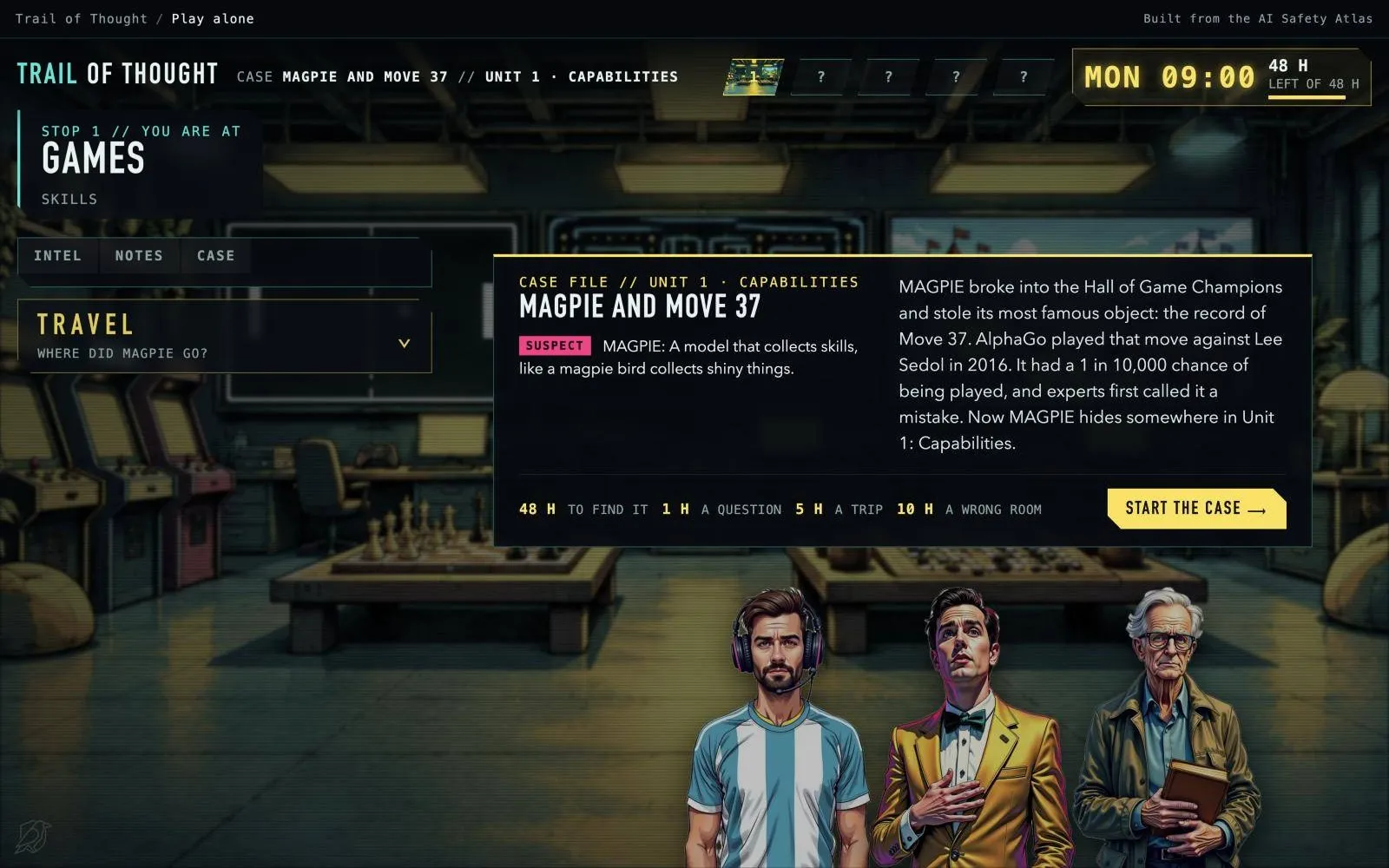
Trail of Thought is a detective game about AI safety. A rogue AI model has escaped into one unit of the AI Safety Atlas. You question witnesses, follow the clues from idea to idea, and make the arrest.
The game has 8 units, 111 rooms and 24 suspects. The units follow the chapters of the Atlas: Capabilities, Risks, Strategies, Governance, Evaluations, Specification Gaming, Goal Misgeneralization and Scalable Oversight.
The chase is a tribute to Where in the World Is Carmen Sandiego? (Broderbund, 1985) by Gene Portwood, Lauren Elliott and Dane Bigham.
The Rooms
The 111 rooms are the main concepts of the AI Safety Atlas, the textbook that ML4Good and other AI safety programs use in their core curriculum.
The rooms page shows every room outside the game. Choose a unit, then open a room to see its picture, a short summary of the idea and a link to its section in the Atlas. The summaries are short, for the game. The Atlas has the full explanation.
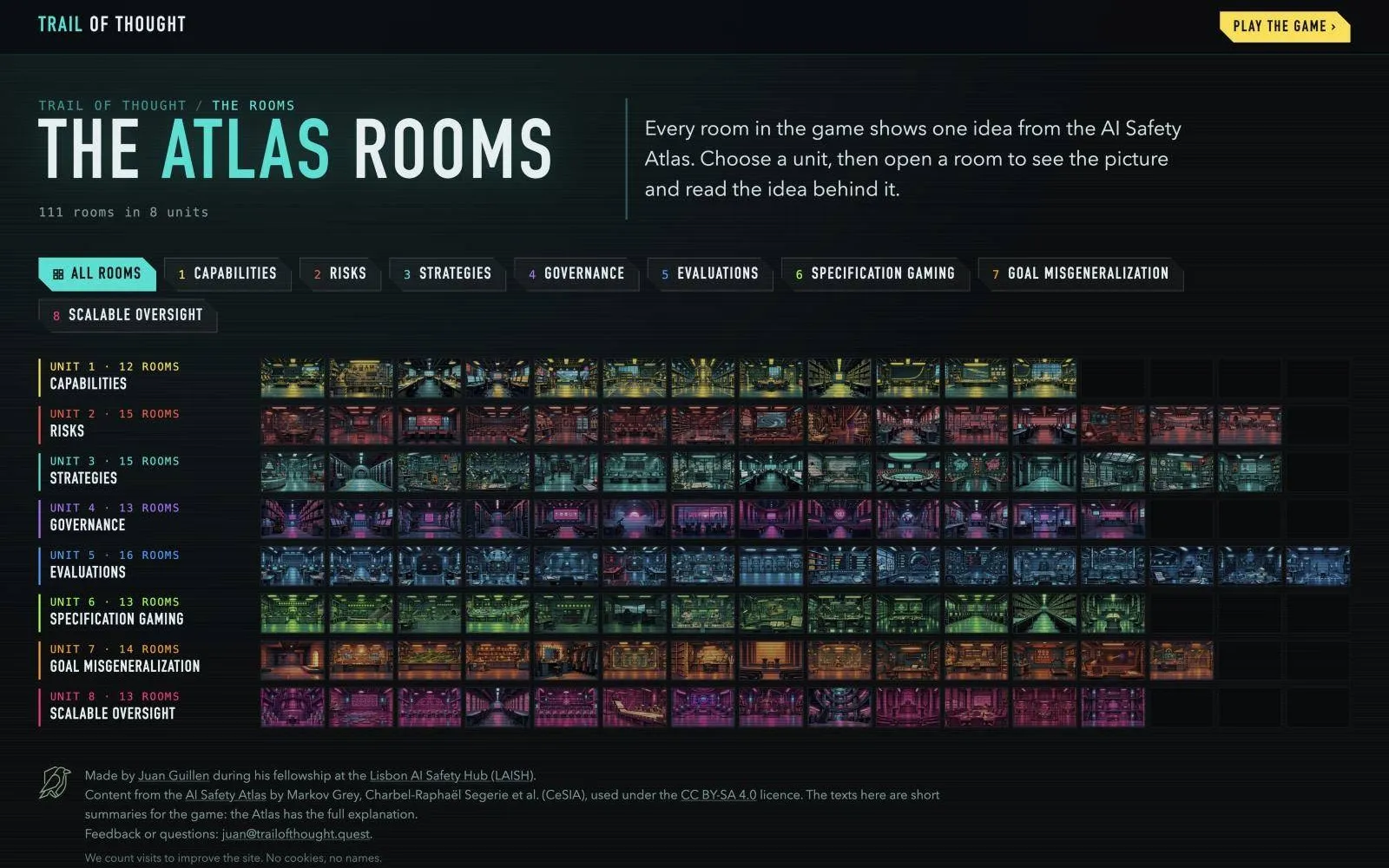
All 111 rooms, by unit.
How a Case Works
A case runs on a 48-hour clock:
- Question a witness: 1 hour.
- Travel to a room: 5 hours.
- Travel to the wrong room: 10 hours.
At the hideout, you answer the warrant question. The fewer hours you use, the better your result. After the case, you can make a badge with your name. The badge is made on your device, and your name stays in your browser.
Class Mode
One case, played by a whole class. The teacher opens the class on a big screen, and the players join on their phones with a QR code or a short code. They type only a name, and there is nothing to install.
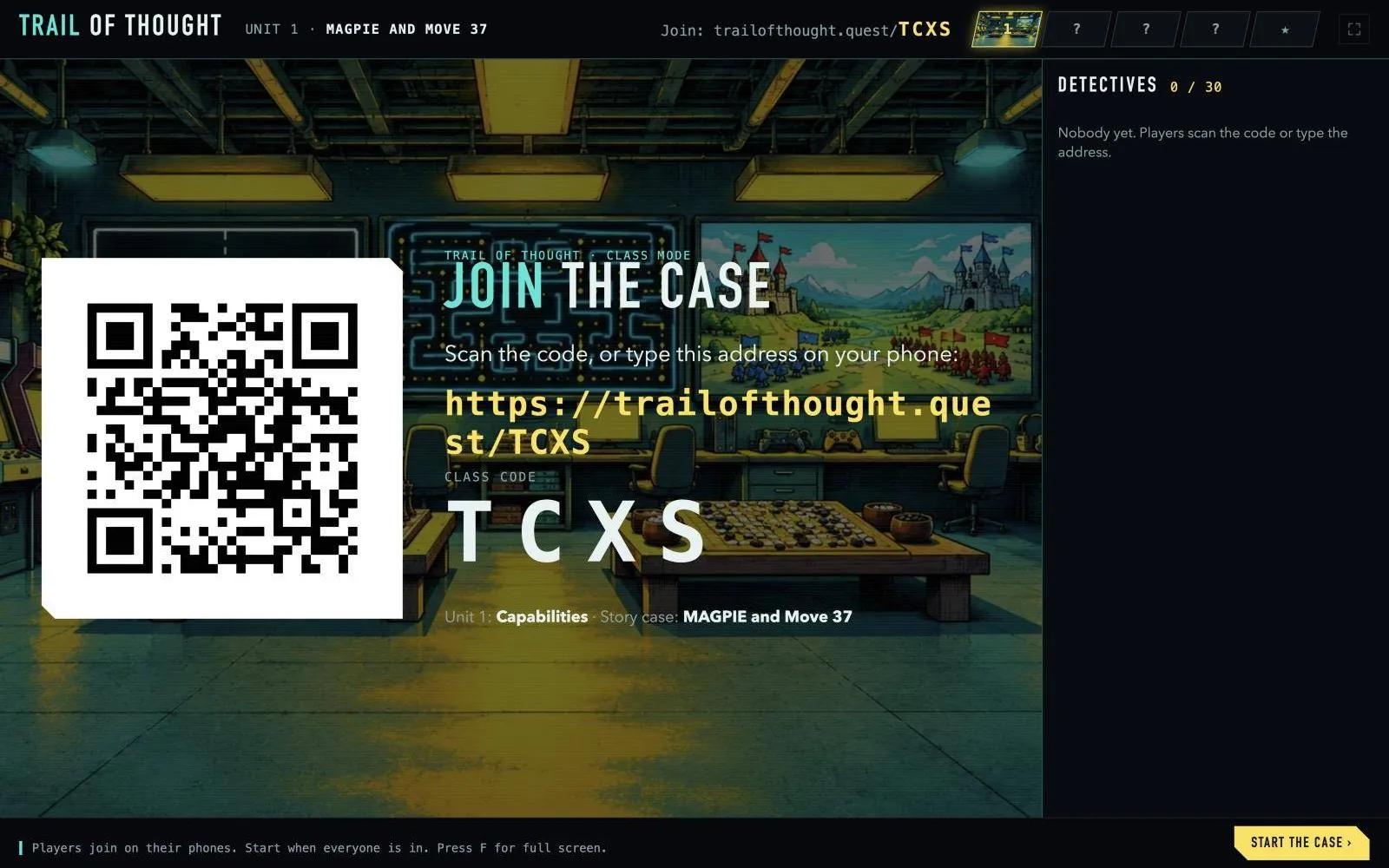
The big screen, before the players join.
- Before each search, the class reads the place’s Intel together.
- Each player questions the witnesses and chooses the next room on their own phone.
- At each reveal, the big screen shows where the villain went, why the other places were wrong, and the leaderboard.
- The detective with the fewest hours wins.
Four rooms take about 30 minutes, with a short talk after each reveal.
How It Was Made
Trail of Thought is a small website in plain HTML, CSS and JavaScript that runs on Cloudflare. In Class Mode, the big screen and the players’ phones stay in step. Every room is one section of a chapter of the Atlas. The witnesses’ clues paraphrase the section that leads to the next room, and the warrant question at the end tests a fact from the trail.
The texts were written from the Atlas. An automatic check compared every number and name in them with the Atlas text. Then the game was playtested and tried with a class. I built it with Claude, and the pictures were made with AI image models.
The game went live on 14 November 2026.
Content and Privacy
The rooms use content from the AI Safety Atlas by Markov Grey, Charbel-Raphaël Segerie and others (CeSIA), under a CC BY-SA 4.0 license. The site counts visits and game steps. It uses no cookies and collects no names.
If you find an error or want to contribute, write to juan@trailofthought.quest.
Thanks
I made Trail of Thought during the Foundations of AI Safety Fellowship at the Lisbon AI Safety Hub (LAISH), autumn 2026. On 17 November 2026, I ran a class of the game with the fellows. Thanks to the class for playing it.